Discover how automotive pressure sensors support engine management, braking systems, EV thermal management and vehicle reliability.
Introduction
As the automotive industry continues to evolve, pressure sensing technology is playing an increasingly important role in vehicle performance, safety, and energy efficiency. From traditional internal combustion engine vehicles to modern electric vehicles (EVs), automotive pressure sensors provide essential real-time data that helps automotive systems operate accurately and reliably.
With the development of vehicle electrification, intelligent driving technologies, and advanced thermal management systems, the demand for high-performance automotive pressure sensors is expanding. Manufacturers are placing greater emphasis on measurement accuracy, long-term stability, durability, and compact sensor design.
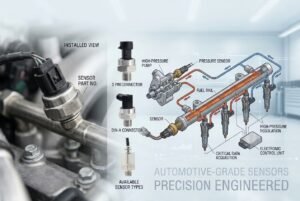
What Is an Automotive Pressure Sensor?
An automotive pressure sensor is a measurement device that detects pressure changes in gases or liquids and converts them into electrical signals. These signals are transmitted to the vehicle’s Electronic Control Unit (ECU) or other control systems for monitoring, adjustment, and system protection.
Depending on the application, automotive pressure sensors can measure absolute pressure, gauge pressure, or differential pressure.
Common automotive pressure sensor technologies include:
- Piezoresistive Pressure Sensors: Convert pressure-induced mechanical deformation into changes in electrical resistance.
- MEMS Pressure Sensors: Use micro-electromechanical technology to achieve compact size, high sensitivity, and integration with electronic circuits.
- Ceramic Pressure Sensors: Utilize ceramic sensing elements for applications requiring chemical resistance, mechanical strength, and stable measurement performance.
The selection of a suitable pressure sensing technology depends on the operating environment, pressure range, measurement accuracy, and system requirements.
Key Applications of Automotive Pressure Sensors
Automotive pressure sensors are widely used in different vehicle systems. Their ability to provide accurate pressure data helps improve operational efficiency, vehicle reliability, and driving safety.
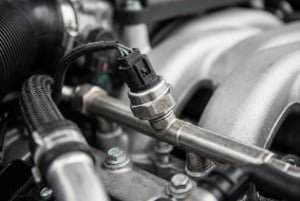
1. Engine Management Systems
In conventional gasoline and diesel vehicles, pressure sensors play an important role in engine management.
Typical applications include:
- Intake manifold pressure monitoring
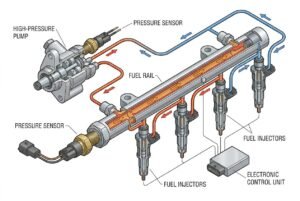
- Fuel rail pressure measurement
- Engine oil pressure monitoring
- Turbocharger boost pressure measurement
- Exhaust gas pressure monitoring
Accurate pressure measurements help the ECU optimize fuel injection, combustion efficiency, and engine operating conditions.
2. Automotive Brake Systems
Pressure sensors are essential components in modern hydraulic braking systems.
They monitor brake fluid pressure and provide feedback to electronic control systems, supporting braking performance and vehicle stability.
High measurement accuracy, fast response, and reliable operation under vibration and temperature variations are important requirements for brake pressure sensing applications.
3. Electric Vehicle Battery Thermal Management
The rapid development of electric vehicles is creating new requirements for automotive pressure sensing technology.
Battery thermal management systems rely on effective temperature and fluid circulation control to maintain suitable battery operating conditions.
Pressure sensors can monitor pressure changes in coolant circuits and related thermal management systems, helping identify abnormal operating conditions and supporting system efficiency.
In addition, pressure monitoring is important in electric vehicle air conditioning and refrigerant systems.
4. Automotive Air Conditioning Systems
Automotive air conditioning systems require accurate pressure monitoring to maintain stable refrigeration performance.
Pressure sensors are commonly used to monitor refrigerant pressure in high-pressure and low-pressure circuits.
Reliable pressure measurement helps control compressor operation, improve cooling efficiency, and provide protection against abnormal pressure conditions.
5. Tire Pressure Monitoring Systems (TPMS)
Tire Pressure Monitoring Systems use pressure sensors to monitor tire inflation pressure.
When tire pressure falls outside the specified range, the system can alert the driver, helping reduce risks associated with underinflated tires.
Accurate and stable pressure measurement is particularly important for maintaining consistent monitoring performance.
Automotive operating environments are demanding. Pressure sensors must maintain reliable performance despite temperature fluctuations, vibration, pressure cycling, and exposure to different operating media.
Several technical factors are particularly important when selecting automotive pressure sensors.
1. High Measurement Accuracy
Accurate pressure measurement enables vehicle control systems to respond appropriately to changing operating conditions.
2. Excellent Temperature Stability
Automotive components may experience significant temperature variations. Sensors with good temperature compensation and low temperature drift help maintain measurement consistency.
3. Long-Term Reliability
Pressure sensing elements must withstand repeated pressure cycles, mechanical vibration, and long-term operation without significant performance degradation.
4. Media Compatibility
Different applications involve different gases, liquids, refrigerants, and other media. The sensing element and wetted materials must be selected according to the specific application.
5. Compact and Integrated Design
As vehicle electronic systems become increasingly integrated, compact sensing elements and pressure modules help simplify installation and support more flexible system designs.
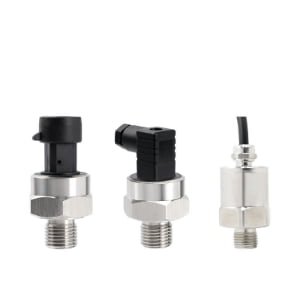
The Future of Automotive Pressure Sensor Technology
The automotive industry is moving toward electrification, intelligent control, and higher levels of system integration.
These developments are creating new opportunities for automotive pressure sensor manufacturers.
Future development is expected to focus on:
- Higher measurement accuracy and improved long-term stability.
- Miniaturized MEMS and advanced ceramic sensing technologies.
- Improved temperature compensation and lower measurement drift.
- Greater integration of sensing elements and signal processing circuits.
- More reliable pressure monitoring solutions for electric vehicle thermal management and other automotive systems.
For sensor manufacturers and automotive component suppliers, continuous improvement in sensing materials, manufacturing processes, calibration technology, and product reliability will remain essential.
Conclusion
Automotive pressure sensors are fundamental components in modern vehicle systems. From engine management and braking systems to electric vehicle thermal management and air conditioning, accurate pressure measurement supports vehicle safety, efficiency, and reliability.
As automotive technologies continue to advance, the demand for pressure sensing solutions with high accuracy, excellent temperature stability, and long-term reliability will continue to grow.
For automotive manufacturers and component developers, selecting the right pressure sensing element and pressure module is an important step toward building more reliable and efficient vehicle systems.
About Shenzhen Ould Instrument Co., Ltd.
Founded in 2002 and headquartered in Shenzhen, China, Shenzhen Ould Instrument Co., Ltd. specializes in the research, development, manufacturing, and sales of pressure, temperature, and level transmitters, ceramic pressure sensing elements, and pressure modules.
With a focus on pressure sensing technology, material performance, and measurement stability, Ould provides pressure sensing components and technical solutions for industrial equipment and related applications.
For inquiries about pressure sensing elements, pressure modules, or customized measurement solutions, please contact our technical team.