Ceramic pressure sensor cores are important sensing components used in pressure measurement systems across automotive, industrial, hydraulic, pneumatic, and fluid control applications.
As the demand for compact, stable, and application-specific pressure measurement solutions continues to grow, ceramic sensing technology has become an important option for sensor designers and OEM manufacturers.
However, not all ceramic pressure sensor cores use the same measurement principle or structural design. Piezoresistive and capacitive ceramic sensing technologies, for example, convert pressure into electrical signals in different ways.
Understanding these differences is essential when selecting a suitable ceramic pressure sensing element for a particular application.
1. What Is a Ceramic Pressure Sensor Core?
A ceramic pressure sensor core is the primary sensing component that detects applied pressure and converts mechanical deformation into an electrical change.
Alumina (Al₂O₃) is commonly used in ceramic sensing structures because of its hardness, electrical insulation properties, and resistance to many chemical environments.
A typical ceramic sensing assembly may include:
-
A ceramic diaphragm or sensing membrane
-
A ceramic base or supporting structure
-
Resistive or capacitive sensing elements
-
-
Bonding or sealing interfaces
The actual configuration depends on the measurement principle and the intended application.
Unlike a complete pressure transmitter, a ceramic sensing core does not necessarily include signal amplification, temperature compensation, electrical protection, or a standardized output interface.
These functions may be added at the module or finished-sensor level.
2. Two Common Ceramic Pressure Sensing Technologies
Ceramic pressure sensing technology can use different electrical measurement principles. Two important examples are piezoresistive and capacitive sensing.
In a ceramic piezoresistive sensor, pressure causes a small deformation in the ceramic diaphragm.
Resistive sensing elements respond to the resulting mechanical strain by changing their electrical resistance.
These resistors can be arranged in a Wheatstone bridge circuit to produce an electrical signal related to the applied pressure.
The signal is then processed by external electronics or an integrated signal-conditioning circuit.
Typical design considerations include:
-
Bridge resistance and excitation requirements
-
Sensitivity and output characteristics
-
Nonlinearity and hysteresis
-
Temperature-related zero and span changes
-
Mechanical stress and mounting conditions
This technology is commonly used in industrial and pressure transmitter designs.
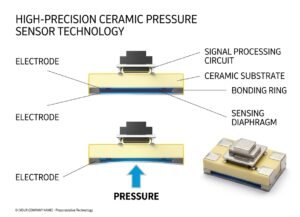
A ceramic capacitive pressure sensor uses changes in capacitance to detect pressure.
Its sensing structure typically consists of two conductive electrode surfaces separated by a small gap or dielectric structure.
When pressure deflects the ceramic diaphragm, the spacing between the electrodes changes. This produces a measurable change in capacitance.
An electronic circuit measures and processes this capacitance change to determine the applied pressure.
Important design considerations include:
-
-
-
-
Temperature characteristics
-
Electrical noise and parasitic capacitance
The final performance depends on the complete mechanical and electronic design, not simply the ceramic material.
3. Key Advantages of Ceramic Pressure Sensing Elements
Ceramic sensing elements offer several useful material characteristics for pressure measurement applications.
Chemical Resistance
Alumina ceramic can provide good resistance to many chemicals and corrosive media.
This makes it a potential choice for applications involving certain oils, fluids, gases, and industrial process media.
However, compatibility must always be evaluated for the complete wetted assembly, including seals, electrodes, housing materials, and bonding interfaces.
Mechanical Hardness
Ceramic materials are generally hard and resistant to surface wear.
This property can be beneficial in pressure measurement environments where the sensing surface is exposed to demanding operating conditions.
Electrical Insulation
Alumina ceramic is electrically insulating, which can support the design of electrically isolated sensing structures.
Design Flexibility
Different ceramic geometries, diaphragm structures, sensing principles, and electronic configurations can be developed to meet different measurement requirements.
Nevertheless, ceramic is also a brittle material. Mechanical stress concentration, improper mounting, impact, and material bonding must be considered during design.
4. Piezoresistive vs. Capacitive Ceramic Pressure Cores
The two technologies have different signal-generation mechanisms and electronic integration requirements.
| Comparison |
Piezoresistive Ceramic |
Capacitive Ceramic |
| Measurement principle |
Resistance change |
Capacitance change |
| Typical sensing structure |
Resistive bridge |
Capacitor electrodes |
| Signal processing |
Bridge signal conditioning |
Capacitance measurement circuit |
| Main design considerations |
Bridge sensitivity, drift, linearity |
Capacitance stability, parasitic effects |
| Integration requirements |
Excitation and signal amplification |
Capacitance-to-digital or equivalent processing |
Neither technology is automatically superior for every application.
The correct selection depends on the pressure range, operating environment, required accuracy, mechanical structure, electronic interface, and total system cost.
5. How to Select the Right Ceramic Pressure Sensor Core
Before selecting a ceramic sensing element, engineers should define the actual operating conditions.
Pressure Range and Measurement Type
Determine the required pressure range and whether the application requires gauge, absolute, or sealed-gauge measurement.
The nominal operating pressure should be considered together with possible pressure spikes and overload conditions.
Media Compatibility
Identify the measured medium, including its chemical composition, concentration, operating temperature, and potential contamination.
The ceramic sensing surface may be compatible with a medium while the complete sensor assembly is not.
Temperature Characteristics
Consider both the operating temperature of the measured medium and the surrounding environment.
Temperature can influence the mechanical properties of the sensing structure and the electrical characteristics of the measurement circuit.
Accuracy and Long-Term Stability
Review the following parameters:
It is important to compare specifications using the same measurement conditions and accuracy definitions.
Mechanical and Electrical Integration
Check the core dimensions, mounting structure, electrical connection, bonding requirements, and compatibility with the intended pressure transmitter housing.
A sensing core that performs well independently may require additional mechanical and electronic optimization when integrated into a complete product.
6. Ceramic Pressure Cores in Automotive and Industrial Applications
Ceramic sensing elements can be considered for a range of applications, depending on the material configuration and complete sensor design.
Automotive Systems
Pressure measurement in vehicle thermal management, hydraulic systems, compressors, and other fluid circuits may use ceramic sensing technology where the application requirements are compatible with the design.
Industrial Compressors
Pressure measurement in compressor systems requires attention to pressure range, pulsation, vibration, temperature, and media compatibility.
Hydraulic and Pneumatic Equipment
Hydraulic and pneumatic applications may involve dynamic pressure changes and mechanical shock, making overload characteristics and mounting design important selection factors.
HVAC and Refrigeration
Refrigeration applications require careful evaluation of refrigerant compatibility, temperature cycling, sealing, and pressure range.
7. Ceramic Sensing Core vs. Complete Pressure Transmitter
A ceramic pressure core is only one part of a complete pressure measurement solution.
A finished pressure transmitter may also include:
-
Mechanical pressure housing
-
-
Signal-conditioning electronics
-
-
-
-
Calibration and protective functions
For OEM projects, it is important to decide whether the application requires an individual sensing core, an electronic pressure module, or a fully assembled pressure transmitter.
This decision influences system integration, development cost, electrical design, and production requirements.
Ceramic pressure sensor cores provide useful sensing options for automotive and industrial pressure measurement applications.
Piezoresistive and capacitive technologies offer different approaches to converting pressure into electrical signals. Their suitability depends on the sensing structure, material configuration, signal praocessing, and actual operating conditions.
For OEM manufacturers, selecting the right ceramic pressure core requires evaluating pressure range, media compatibility, temperature behavior, accuracy, mechanical integration, and electrical requirements together.
Looking for a suitable ceramic pressure sensing solution?
OULD offers ceramic-based pressure sensing products and pressure measurement solutions for different industrial and OEM applications.
Contact our team to discuss your required pressure range, measurement medium, installation dimensions, and sensing technology.