Pressure sensors play an important role in modern air compressor systems. They provide pressure feedback for equipment monitoring, compressor control, and pneumatic system management.
From rotary screw compressors to compressed air storage tanks and industrial pneumatic networks, accurate pressure measurement helps equipment operators understand system conditions and maintain reliable operation.
However, selecting an air compressor pressure sensor involves more than matching the nominal pressure range. Engineers must also consider pressure fluctuations, operating temperature, vibration, electrical output, process connections, and media compatibility.
This guide explains the key factors to consider when selecting a suitable pressure sensor for an air compressor application.
1. Understand Where Pressure Measurement Is Required
Before choosing a sensor, identify the exact measurement location and its purpose.
Different locations in an air compressor system may have different pressure conditions.
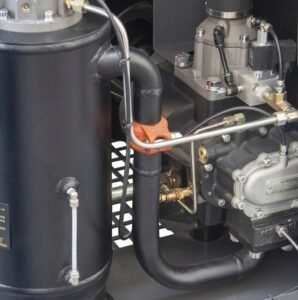
Compressor Discharge Pressure
A pressure sensor installed at the compressor discharge can provide feedback about the pressure generated by the compressor.
The measurement point may experience pressure fluctuations, temperature changes, and mechanical vibration.
Air Receiver Pressure
An air receiver stores compressed air and helps stabilize the supply to downstream equipment.
A pressure sensor at the receiver or associated piping can monitor system pressure and support compressor loading and unloading control.
Oil-Gas Separator Pressure
Rotary screw compressors often include an oil-gas separation system.
Pressure monitoring in this section can help operators evaluate operating conditions and identify abnormal pressure changes.
Where pressure drop across a filter or separator must be measured, a differential-pressure transmitter or two appropriately configured pressure measurement points may be required.
Pneumatic Distribution Systems
Compressed air distribution networks supply pneumatic cylinders, valves, actuators, and industrial machinery.
Pressure sensors can be installed at selected locations to monitor supply pressure and help identify pressure losses within the system.
The measurement location should be determined before selecting the sensor because pressure, temperature, and media conditions can vary throughout the system.
Pressure range is one of the most important selection parameters.
The selected range should cover the normal operating pressure while also accounting for expected transient pressure conditions.
For example, an air compressor application may require different pressure ranges depending on whether the sensor monitors a low-pressure pneumatic line, a compressor discharge line, or a higher-pressure booster system.
Consider the following factors:
-
Normal operating pressure
-
Maximum expected operating pressure
-
Startup and shutdown pressure changes
-
Transient pressure spikes
-
Allowable overload pressure
-
Required measurement resolution
A sensor with an unsuitable range may produce insufficient measurement detail or be exposed to pressure conditions beyond its specified limits.
It is also important to distinguish between operating pressure, overpressure, and burst pressure. These terms describe different limits and should not be used interchangeably.
3. Consider Temperature and Environmental Conditions
Air compressor pressure sensors may operate in environments with significant temperature variations.
The temperature at the compressor discharge may be higher than the temperature in the downstream air receiver or distribution piping.
When choosing a sensor, evaluate:
Medium Temperature
Determine the temperature of the compressed air or other measured medium at the actual installation point.
Ambient Temperature
Consider the temperature surrounding the sensor, including heat generated by the compressor motor, enclosure, and nearby equipment.
Temperature Drift
Temperature changes may influence the sensor’s zero point and measurement sensitivity.
Check whether the manufacturer’s temperature specification describes the compensated operating range, total error, or temperature drift separately.
Vibration and Mechanical Shock
Compressors contain moving mechanical components that can generate continuous vibration.
A sensor should have a suitable mechanical structure and electrical connector for its intended installation environment.
Cable routing, connector locking, mounting support, and mechanical resonance should also be considered.
4. Check Pressure Pulsation and Dynamic Response
Pressure in an operating compressor system is not always constant.
Depending on compressor type, operating speed, valve action, and piping configuration, pressure signals may contain pulsations and transient changes.
A suitable pressure sensor should be evaluated for:
-
-
Dynamic frequency response
-
-
Resistance to mechanical vibration
-
Stability under repeated pressure cycles
In some installations, a pressure snubber or restrictor may be used to reduce unwanted pressure pulsations.
However, damping can also slow the sensor’s response and may become obstructed by contamination.
The damping design should therefore be selected according to the actual measurement objective rather than added automatically.
If rapid pressure changes need to be detected, verify the complete sensor’s dynamic response under representative conditions.
5. Choose the Correct Electrical Output Signal
The output signal must match the compressor controller or monitoring system.
Common output options include:
| Output Signal |
Typical Integration Considerations |
| 0–5V |
Requires a compatible analog voltage input |
| 0.5–4.5V |
Common in three-wire sensor configurations |
| 4–20mA |
Suitable for many industrial control systems |
| Digital output |
Requires a compatible communication interface |
For voltage-output sensors, verify the supply voltage, signal range, grounding arrangement, input impedance, and cable configuration.
For 4–20mA transmitters, check the loop supply voltage, receiver resistance, wiring, and available voltage margin.
Never assume that two sensors with the same connector shape have the same electrical pinout.
6. Verify the Process Connection and Wetted Materials
The mechanical interface must match the installation point.
Common industrial pressure connections include:
These thread types are not interchangeable simply because their nominal dimensions appear similar.
Confirm the exact thread standard, sealing method, mounting space, and allowable installation torque.
Also evaluate the materials exposed to the measured medium.
For compressor applications involving compressed air, oil mist, or other fluids, compatibility should be checked for the complete wetted assembly, including the pressure port, diaphragm, seals, and internal isolation structure.
Do not assume that a stainless steel housing automatically guarantees compatibility with every compressor lubricant or process medium.
7. Consider Electrical Protection and Installation
A pressure transmitter may be installed in a compact compressor enclosure or exposed industrial environment.
The complete installation should consider:
-
Moisture and dust protection
-
-
-
Electromagnetic interference
-
-
-
Maintenance accessibility
Follow the sensor manufacturer’s installation instructions and the compressor system’s safety procedures.
Before removing or replacing a pressure transmitter, isolate the equipment and release trapped pressure according to the applicable maintenance procedure.
A pressure sensor is a measurement component. It should not be treated as a substitute for an independently required pressure relief or safety protection device.
8. Example: Selecting a Pressure Sensor for a Screw Air Compressor
Consider an OEM developing a rotary screw air compressor that requires pressure feedback for system monitoring and control.
The engineering team should first define:
-
The exact pressure measurement location.
-
The normal and maximum operating pressure.
-
The expected pressure pulsation and vibration.
-
The medium and temperature conditions.
-
The controller’s electrical input requirements.
-
The process thread and connector configuration.
-
The environmental protection requirements.
The selected pressure transmitter must meet the combined mechanical, electrical, and environmental requirements.
For OEM applications, confirming the complete specification before ordering can reduce integration problems and unnecessary design changes.
9. OULD PT-306 Air Compressor Pressure Sensor
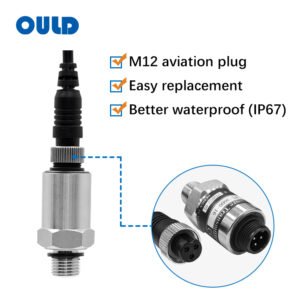
For applications involving compressor pressure measurement, OULD offers the PT-306 air compressor pressure transmitter.
The product is presented for air compressors, pneumatic machinery, and other industrial pressure measurement applications.
According to the current PT-306 product listing, its published configurations include:
| Parameter |
Published Information |
| Pressure Range |
0–10 bar / 0–16 bar / 0–40 bar |
| Accuracy |
±0.5% FS / ±1.0% FS |
| Output Signal |
0–5V / 4–20mA |
| Operating Temperature |
-40°C to +85°C |
| Overload Pressure |
200% FS |
| Process Connection |
G1/4, R1/4, NPT1/4, customizable |
| Electrical Connection |
Aviation connector |
Available configurations and specifications should be confirmed against the selected model and order requirements.
For example, the voltage-output version, power supply, connector pinout, and pressure reference should be verified before electrical integration.
The PT-306 may be considered for suitable compressor and pneumatic equipment projects where its actual configuration meets the application requirements.
Product reference: PT-306 Air Compressor Pressure Sensor with Aviation Connector
Selecting an air compressor pressure sensor requires evaluating the complete operating environment rather than focusing on pressure range alone.
Pressure fluctuations, temperature, vibration, media compatibility, output signal, process connection, and installation conditions all influence the suitability of a pressure transmitter.
For compressor manufacturers and industrial OEMs, defining these requirements early can help identify a reliable pressure measurement solution.
Looking for an air compressor pressure sensor for your OEM application?
Explore OULD’s PT-306 pressure transmitter or contact our team to discuss your required pressure range, electrical output, process connection, and customization requirements.